Dialect 5 News
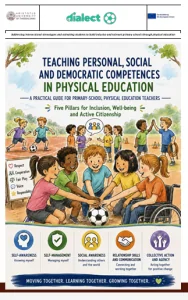
As part of the DIALECT 5 project, the Aristotle University of Thessaloniki (AUTH) developed a new educational resource entitled “Teaching Personal, Social and Democratic Competences in Physical Education: A Practical Toolkit for Physical Education Teachers”. Building on the findings of the project’s Needs Assessment and previous DIALECT resources, the toolkit was adapted to the context of primary education, addressing the needs of Physical Education professionals working with children aged 9–12. It combines the established DIALECT methodology with new elements of democratic education, placing particular emphasis on equality, non-discrimination and children’s active participation in decisions that affect them. The toolkit provides practical pedagogical approaches and activities to help Physical Education teachers create inclusive, engaging and socially responsible learning environments. Through movement-based activities, team games, structured reflection and the football3 methodology, it promotes the development of personal, social, emotional and democratic competences, including self-awareness, empathy, cooperation, conflict resolution, respect for diversity and collective responsibility. Incorporating feminist and intersectional perspectives, the resource also addresses the diverse backgrounds and experiences of children, ensuring that every child has equal opportunities to participate, express their voice and contribute to the group. To support its implementation across the four participating countries, the adapted toolkit was also translated into the partners’ national languages and are available to download in the outcomes section of DIALECT5.
0